Pax Americana: D.B. Weldon Library (2026)
A continuation of my Pax Americana series, the 20 plaques and 16 books in this collection were made for the D.B. Weldon Library at Western University. Below are images of the plaques.
To view the books, please click here.
Pax Americana is an art series that reimagines Canada as a site of future conflict and occupation. Fragments of the story of how Canada was absorbed by the United States are revealed, as well as what became of us afterward. The series began in March, 2025, after President Donald Trump’s repeated threats to make Canada the 51st state. Since then, plaques have been posted in Toronto, Ottawa, Tofino, London and Montreal. The series is ongoing.
The selection of Weldon for this exhibit reflects the central role that libraries play in university life. On opening in 1972, Weldon established a campus heart and eventually helped form the University’s first quad and central campus hub. Weldon was intentionally designed as a place for community: a space to gather, access information, exchange ideas, and create new knowledge. Today, the spaces where we gather, the information we can access, and the ideas we are free to share are all under threat in a world where sovereignty is increasingly challenged.
This exhibit was made possible through contributions from Western's Program in International Relations, Western Libraries, the History Department, the Student Donation Fund, and the Association of International Relations (AIR).
*View the plaques installed across Canada here.
*View the plaques installed at the Massachusetts State House here.
*Support the project here.
*Read about the series in the New York Times, CBC Arts, and CBC News. Listen on CBC Radio London.


Faculty of Corrections, 2026, 20 x 24", Durablack.
"Following unification in 2035, officials concluded that this building’s historical dedication to Colonel Douglas Black Weldon no longer aligned with current ideological mandates. To facilitate a smooth transition and minimize student disruption, the institution adopted a new identity as the Western Electronic Library & Data Organization Network (WELDON).
Home to many important initiatives, this space also hosts the Faculty of Corrections. The Faculty’s mandate is to ensure that all books are presented as their most up-to-date versions, filtering out inanities and inaccuracies left over from the previous regime. Staff members work closely with AI and governmental agencies to ensure that everyone receives the best possible information in real time.
This plaque commemorates the 10,000th book corrected, Lucy Maud Montgomery’s Anne of Green Gables, an iconic tale of a young girl’s coming-of-age in New England."


Jimmy Grenville: A Life of Service, 2026, 20 x 24", Durablack.
"Born in Victoria (present-day Fort Victory), in the former nation of Canada, Jimmy Grenville was a noted patriot, celebrated for his role in the stabilization of Canadian universities. He was educated at the University of Central Florida, where he completed a degree in American Studies, before returning north to take an adjunct post at Western University in 2033.
In 2035, American troops began realigning Canadian universities. Caught by surprise, a skirmish broke out between Patriot forces and members of the campus Improv Club. On February 8, 2035, the Club’s rebel members barricaded themselves in one of the stairwells at WELDON. The standoff continued for days until Grenville, familiar with the library’s floor plans, was able to alert Patriot forces to an unfortified door. This strategic ingress allowed troops to extract the insurgents, who were subsequently deported.
Grenville is also notable for founding the United Brothers of Manifest Destiny Historical Society. As part of its mandate, the United Brothers regularly staged historical reenactments, including the campus pacification in which Grenville had played such a pivotal role. It was during one such reenactment that Grenville met his future wife, Jane. Grenville, portraying himself, was able to capture Jane, who was performing the role of a Canadian Stairwell Insurgent. The two later married and went on to have six children."


Project Homecoming Filming Location, 2026, 20 x 24", Durablack.
"Released in 2038, Project Homecoming, the flag-waving rock musical, tells the tale of Tommy Kazansky (Ryan Reynolds), America’s favorite ICE agent, and his lovable sidekick, a K-9 patrol dog named Payback. Armed with charisma and a keytar, the two crisscross the country reminding illegals that everyone belongs somewhere—just not here.
Standing in for ICE headquarters, this building served as a backdrop for two memorable musical numbers in the film. The first, “Paw Patrol (Three Barks Means We Found You),” was a duet between Reynolds and Payback; the second was a solo by Sabrina Carpenter entitled “Nice Try, But I Don’t Speak Mexican.”


The Brain Pyramid, 2026, 20 x 24", Durablack.
"In 2037, Robert F. Kennedy Jr., fresh off his triumph against healthcare, turned his focus toward correcting education. Washington held a dark view of the calcification of the school system, concerned that the minds of the future were being poorly shaped by outdated ways of thinking. Universities, particularly those located above the 49th parallel, were seen as outposts of intellectual subversion.
Kennedy’s first action was to implement what became known as the Great Tenure Migration. All professors who had achieved protected employment under the former system were given the choice of relocation abroad or termination. A cohort of young educators was sent north to replace them, implementing a unified curriculum untethered by the constraints of tenure.
Kennedy, who had found great success with his revisions to the Food Pyramid in 2026, created a similar Brain Pyramid. Designed to rebalance academia, the Brain Pyramid ranks fields of study according to their national utility. Revenue-generating fields are located at the base, while non-essential endeavors such as Arts & Humanities are found in the narrow upper tiers. Funding, staffing, and curricular authority were realigned based on where departments were placed within the pyramid, with annual audits used to ensure institutional compliance."

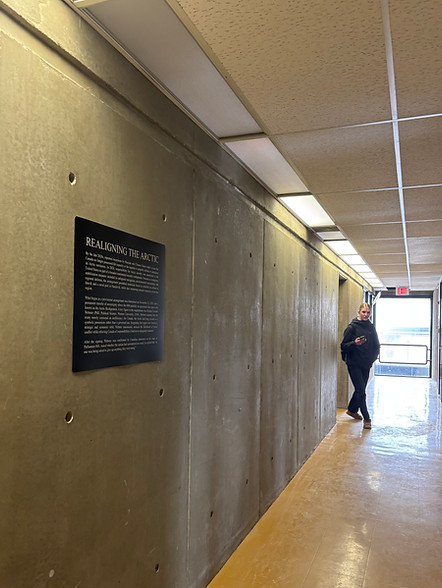
Realigning the Arctic, 2026, 20 x 24", Durablack.
"By the late 2020s, repeated incursions by Russian and Chinese forces made it clear that Canada no longer possessed the capacity or the appetite to properly defend or administer its Arctic territories. In 2028, responsibility for Arctic security was transferred to the United States as part of a broader continental security realignment. Framed as a temporary stabilization measure intended to safeguard navigation, environmental stewardship, and regional defense, the arrangement permitted American forces to establish an airbase in Inuvik and a naval port in Nanisivik, while also extracting mineral resources across the region.
What began as a provisional arrangement was formalized on November 21, 2033, into a permanent transfer of sovereignty above the 60th parallel, an agreement that came to be known as the Arctic Realignment. A key figure in the negotiations was Richard Everard Webster (PhD, Political Science, Western University, 2016). Webster asserted that the treaty merely corrected an inefficiency: for Canada, the Arctic had long existed as a symbolic possession rather than a governed one. Integrating the region into America’s strategic and economic orbit, Webster maintained, reduced the likelihood of armed conflict while relieving Canada of responsibilities it had never adequately assumed.
After the signing, Webster was confronted by Canadian protesters on the steps of Parliament Hill. Asked whether the nation had surrendered too much, he replied that “no one was being asked to give up anything they were using.”"


The Republic of Alberta, 2026, 20 x 24", Durablack.
"The Republic of Alberta (2027-2035) was an experiment in nation-building and a clear rebuke to the incompetence of the former regime. Chafing under the Canadian yoke, the region voted overwhelmingly to separate. Unfortunately, leftist saboteurs interfered with the referendum process, falsifying the results to suggest that Albertans wished to remain trapped within Confederation.
Forever on the side of freedom, the United States Army intervened to secure Alberta’s liberation from Ottawa’s colonial administration. In 2027, the former province established itself as the Republic of Alberta, with the support of its partners to the south.
During the transitional period, William Benjamin Robinson (PhD, Economics, Western University, 2022) served as a key envoy to the United States. His white paper, “America Will Take It From Here: On the Need for Post-National Extraction Zones,” provided the policy foundation for American oversight of Alberta’s energy corridors and supply chains. As he noted at the time, “we cannot allow Canada’s problems to become America’s problems.”
By 2030, it was clear that what remained of Canada was eager to replicate Alberta’s success. Many citizens began calling for American assistance in correcting centuries of incompetence. Following formal unification in 2035, it was decided that Alberta and the rest of the former nation of Canada should be reunited under the banner of the 51st state, a decision undertaken for administrative ease and operational efficiency."


Reparations, 2026, 20 x 24", Durablack.
"Seven years after Canada was assimilated into the United States, President Ivanka Trump based her successful re-election campaign on a platform that included the introduction of Canadian reparations. It had become clear that historic trade imbalances between the formerly independent Canadian territory and the pre-2035 United States would need to be addressed retroactively. In her speech on June 17, 2042, Trump proclaimed: “This is not just recompense for past injustices, but a holistic reckoning that will lead to spiritual renewal across all 51 states.”
The vast majority of the electorate agreed with Trump. Carried on a wave of public sentiment, she swept into the White House for a third term. Her first order of business was to establish a committee tasked with determining the total sum owed. The payment was to be extracted in the form of natural resources, which would then be transferred south for processing. The committee concluded that the sum could not be precisely quantified. Instead, fulfillment of the obligation would be judged by “a general sense of satisfaction and the evolving needs of the nation,” to be assessed at a later date."


If In Doubt, Point Them Out, 2026, 20 x 24", Durablack.
"Speak up to protect our freedoms."


The Western Archive of Networked Culture, 2026, 20 x 24", Durablack.
"The Western Archive of Networked Culture (WANC), the first of its kind in North America, was founded in 2041 by Theresa Charlebois. Charlebois’ doctoral dissertation, Taxonomies of Rage: Clickbait as a Tool of Governance, formalized Rage Bait Studies as a distinct archival discipline.
The Archive is dedicated to the collection, preservation, and study of materials that reliably provoked disproportionate public response within networked culture. Holdings are preserved as they appeared at the moment of circulation. They include videos, blogs, memes, comment sections, and opinions expressed by citizens over the age of forty. Rather than assessing accuracy or intent, the Archive prioritizes reaction as a historical source. Researchers are invited to examine what activated collective anger at specific moments in time, and what these reactions reveal about social fault lines, institutional trust, and the narrowing boundaries of acceptable discourse. Materials are organized by trigger, virality, and platform.
The Archive is open Monday through Thursday, from 10 a.m. to 4 p.m., or by appointment."


The Jefferson Algorithm, 2026, 20 x 24", Durablack.
"During a 2041 assessment of Western University’s curriculum, faculty concluded that students were no longer capable of reading complete texts. The problem was brought to the Department of Computer Science at Western, then under the command of Lieutenant Colonel Timothy Dwight. Dwight and his team formulated a new algorithm, which they named JEFFERSON, inspired by the Founding Father’s maxim to “never use two words when one will do.”
JEFFERSON was designed to summarize topics into easily digestible tidbits, alleviating much of the reading burden for students at Western. As a result, many books were shipped offsite to make room for other initiatives, including the Faculty of Corrections, the Western Archive of Networked Culture, and the CANSAVE program. Though JEFFERSON can be accessed remotely, many students find that they still enjoy coming to the library to be read aloud to in groups, thus giving them the full university experience."


A Repository for Canadian Culture, 2026, 20 x 24", Durablack.
"Only a few years after the territory’s union with the United States, Canadian culture, such as it was, faced extinction. The Institute of Museum and Library Services (IMLS) began a campaign to catalog the remnants. Known as the Canadian Archival Network for Safeguarding Ancestral Voices and Evidence (CANSAVE), temporary outposts were set up across the state to gather relevant artifacts, texts, footage, and testimonies. All of these materials were carefully inventoried before being sent to WELDON.
Today, WELDON serves an important role as both a repository and an exhibition space, presenting ethnographic displays, screenings, and talks. Among the holdings that can be found in the CANSAVE Wing: an assortment of hockey erotica, ten issues of Chatelaine magazine, a selection of institutional apology statements, several of former Prime Minister Justin Trudeau’s Halloween costumes, and audio samples of regional pronunciations of “about.”"


Bachelor of Reading, 2026, 20 x 24", Durablack.
"By the mid-2040s, literacy had declined precipitously. In an effort to preserve this increasingly marginal practice, the Borgesian Guild of Librarians petitioned Western University’s governing body to establish a degree devoted exclusively to the sustained use of books.
Officially instituted in 2042, the sole requirement of the Bachelor of Reading (BRead) degree was that students read ten books from front to back, selected from an approved list. The degree typically took about six years to complete.
By 2050, participation had begun to wane. Graduates of the program complained that the BRead failed to provide clear pathways to employment, leaving them uncertain how to translate their education into stable work. As one online critic observed, “Anyone who says that they read books only says that to sound smart. Nobody reads anymore, and nothing bad has happened.”
The program was discontinued in 2052."

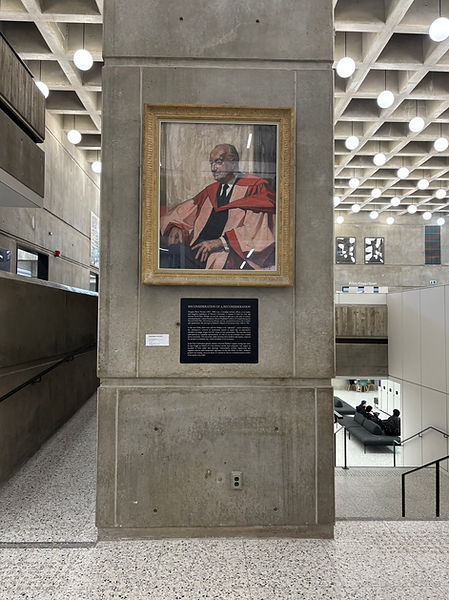
Reconsideration of a Reconsideration, 2026, 20 x 24", Durablack.
"Douglas Black Weldon (1895–1980) was a Canadian military officer, civic leader, and longtime benefactor of Western University. A veteran of both the First and Second World Wars, Weldon served with distinction and rose to the rank of colonel, commanding the London Regiment (Royal Highland Fusiliers of Canada) during the Second World War. Following his military service, he played an active role in public and institutional life, serving on Western’s Board of Governors from 1946 to 1967.
In the mid-2020s, there were calls for Weldon to be “canceled”—a term referring to the retrospective removal of institutional honors to signal that an individual’s elevation no longer aligns with the values of later generations. This was due to his participation in Canadian militarization, as well as his involvement with colonial power structures. The university, under pressure from students and faculty, removed his portrait to eliminate any visual reminders of his existence.
In the Post-Unification period, scholars revisited Weldon’s legacy, noting that while he had fought on behalf of a now-defunct nation, such allegiance was largely an accident of birth rather than ideology. Concurrently, military frameworks had regained cultural and institutional legitimacy by the late 2030s. In 2043, Weldon’s portrait was rehung, not as an object of veneration, but as a recontextualized artifact of an earlier civic order."


The Women's Section, 2026, 20 x 24", Durablack.
"In 2036, library administration designated this as a separate study area for women. Dedicated to nurturing our female learners, the space is designed to be safe and inclusive. The books in this section are specially curated, and many are abridged and/or revised. In the words of Mary Wollstonecraft, “If children are to be educated to understand the true principle of patriotism, their mother must be a patriot.”
This area is not to be confused with the Women’s Studies section, which has been relocated to the History section on the ninth floor. Access to that area is restricted. To apply for a permit, please email Clifford McCreery, current Dean of Women, at cmcreery@weldon.gov."


The Borgesian Guild of Librarians, 2026, 20 x 24", Durablack.
"WELDON is a proud member of the Borgesian Guild of Librarians (BGL). Founded in 2027 by Solange Marianne, the Guild was established to address the evolving role of libraries and librarians in a rapidly changing technological landscape.
Born in Pre-Unification Canada, Marianne spent three decades working as a librarian before the Great Technological Shift of 2026, when Artificial Intelligence and Large Language Models rendered traditional library functions obsolete.
Drawing inspiration from the writings of Jorge Luis Borges, Marianne proposed a new philosophical framework for information stewardship. Her four tenets were: 1) Meaning is no longer scarce, but indistinguishable. In a system capable of generating every possible text, significance ceases to be inherent and exists only as a private act of recognition. 2) Forgetting is a curatorial act. In an era of total recall, forgetting becomes the primary responsibility of the librarian. 3) Completion is a category error. No text can be final when all variations already exist; attempts at completeness are therefore vulgar. 4) Authorship is incidental. All texts are anonymous in origin and infinite in revision.
These principles spread rapidly to libraries around the world, with institutions adopting Marianne’s doctrine as a means of navigating the illusion of knowledge in the post-human archive. The Guild grew in power, though by 2040 it was determined that Marianne herself was no longer instrumental to its functioning. Found to be harboring a trove of unauthorized books, Marianne was relocated to Qaanaaq in 2041."


One Nation Under God and English, 2026, 20 x 24", Durablack.
"By the end of the 2030s, after the addition of several new and exotic territories to the United States’ portfolio, it was determined that the Pledge of Allegiance needed an update. Various foreign languages still in use were seen to be creating unnecessary friction in domestic commercial enterprises, and a single linguistic framework was deemed essential. Similarly, in the face of existential threats from foreign powers, Washington concluded that manifest destiny must be reflected by a singular verbal destiny.
On Independence Day, 2041, the Pledge of Allegiance was modified to read: “I pledge allegiance to the Flag of the United States of America, and to the Republic for which it stands, one Nation under God and English, indivisible, with liberty and justice for all.”
This plaque marks the federal credentialing of this building as an English-only space, certified on June 24, 2042."


10th Mountain Division Barracks, 2026, 20 x 24", Durablack.
"This building was requisitioned in 2035 to house elements of the United States Army’s 10th Mountain Division during Operation McKinley, the campaign to liberate the northern territory formerly known as Canada. The division occupied the site for approximately eighteen months before oversight was transferred to local authorities.
The division, trained for close-quarters combat and population control, found itself underutilized. Briefed for guerrilla activity, sabotage, and widespread resistance, soldiers instead encountered a local population that was, with few isolated exceptions, apathetic toward the newly instituted American presence. Major Alexander Knox, then in control of the region, observed: “We knew we were the winning team, but we expected more of that hockey-goon lumberjack stuff you used to see in beer commercials.”"


The Philip Morris International Scrolling Garden, 2026, 20 x 24", Durablack.
"Welcome to the Philip Morris International Scrolling Garden, made for those seeking a respite from knowledge and learning. A safe space, the Scrolling Garden allows visitors to use their devices without distraction or interruption.
Imagined by architect Andrew John (BA, Visual Arts, Western University, 2014), the space was designed to be intentional and deeply symbolic. Its inward-facing position within the building allows for connection without engagement, carefully negotiating the boundaries between inside and outside, exposure and openness. The mixed textures of the walls gesture toward diversity, while the corners serve as a spatial refuge from the wide open—a place to step outside while still being within the comfort of one’s limits.
This plaque marks the official unveiling of the Scrolling Garden on February 6, 2041."


The Atlas Riots, 2026, 20 x 24", Durablack.
"On October 16, 2037, students assembled in front of the WELDON building to demand the divestment of books deemed “unpatriotic.” The unrest began after it was revealed that the collection still contained atlases that referenced the former border at the 49th parallel. Enraged, students demanded that all texts whose origins, languages, or political views failed to align with general opinion be removed, and that ties with publishers, donors, and authors who were complicit be severed.
A group of approximately twenty-five students entered the library on the evening of October 19 and began destroying volumes that looked offensive. After the riot had been quelled, librarians noted that the group had been unable to properly locate the Reference Section, ultimately leaving most of the atlases unscathed.
Though campus administrators condemned the disruption, they acknowledged the Library’s responsibility to maintain a collection appropriately aligned with community and national values. The protests sparked the Make Books Great Again movement, which would produce the most sweeping cultural realignment of the printed word in a generation, ensuring that future readers encountered only works that are constructive and patriotic."

